 Insurance Coverage & Costs
Access to Care
Uninsured and Low-Income
Racial/Ethnic Disparities
Safety Net Providers
Community Health Centers
Hospitals
Physicians
Insured People
Quality & Care Delivery
Health Care Markets
Issue Briefs
Data Bulletins
Research Briefs
Policy Analyses
Community Reports
Journal Articles
Other Publications
Surveys
Site Visits
Design and Methods
Data Files
Insurance Coverage & Costs
Access to Care
Uninsured and Low-Income
Racial/Ethnic Disparities
Safety Net Providers
Community Health Centers
Hospitals
Physicians
Insured People
Quality & Care Delivery
Health Care Markets
Issue Briefs
Data Bulletins
Research Briefs
Policy Analyses
Community Reports
Journal Articles
Other Publications
Surveys
Site Visits
Design and Methods
Data Files

|
||
| March 2000 Issue Brief No. 28 |
||
The Scope of Care Expected of Primary Care Physicians: Issue Brief No. 24 |
||
| Winter 1999/2000 Inquiry |
||
| Winter 1999/2000 Inquiry |
||
Snapshots of Change in Fifteen Communities: Health Affairs |
||
Access to Specialists:
Perspectives of Patients and Primary Care Physicians
Data Bulletin No. 02
Fall 1997
Robert F. St. Peter
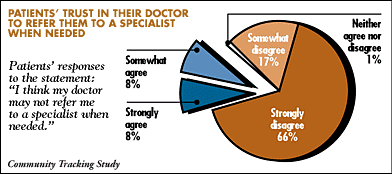
 ost Americans (83 percent) have confidence that their physician will refer them to specialists when necessary, but a sizable proportion -- 16 percent -- are concerned that their doctor might not refer them to a specialist when needed, according to findings from the Household Survey conducted by the Center for Studying Health System Change. The percent concerned varies considerably across communities -- from a low of 11 percent in Lansing to a high of 22 percent in Miami. (See table below.)
REFERRALS BY PRIMARY CARE PHYSICIANS
 n important aspect of patients’ relationships with their physicians is their trust that physicians will make decisions in patients’ best interest, including providing referrals for specialty care when medically necessary. Recent changes in the health care market, including the growth of managed care, have led to a more formalized role for primary care physicians in providing referrals to specialists.
In addition, various utilization management procedures and financial incentives now exist that are designed to encourage primary care physicians to reduce the use of unnecessary or inappropriate services, including some specialty referrals. Some physicians and patients have expressed concern that these incentives may restrict patients’ access to specialists, even when their services may be beneficial.
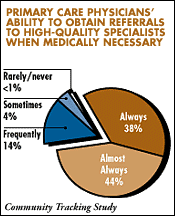
According to the Center’s Physician Survey, most primary care physicians (82 percent) report that they are always able or almost always able to obtain referrals for their patients to high-quality specialists when medically necessary. However, nearly one out of five (18 percent) primary care physicians report that they cannot always or almost always obtain referrals to high-quality specialists, even when medically necessary. (See pie chart below.)
The problem is worse in some communities than others. Primary care physicians practicing in Miami (31 percent) and Newark (31 percent) are more likely, and those in Indianapolis (6 percent) and Boston (12 percent) less likely, to report difficulty obtaining referrals to high-quality specialists.
| Patients agreeing that their doctor might not refer them to a specialist when needed | Primary care physicians reporting that they cannot always or almost always obtain referrals to high-quality specialists when medically necessary | |
| Boston, Mass. | ||
| Cleveland, Ohio | ||
| Greenville, S.C. | ||
| Indianapolis, Ind. | ||
| Lansing, Mich. | ||
| Little Rock, Ark. | ||
| Miami, Fla. | ||
| Newark, N.J. | ||
| Orange County, Calif. | ||
| Phoenix, Ariz. | ||
| Seattle, Wash. | ||
| Syracuse, N.Y. | ||
| Metropolitan areas over 200,000 pop. | ||
| United States | ||
| *Site value is significantly different from mean for metropolitan areas over 200,000 population.
Community Tracking Study |
||
A COMMUNITY PERSPECTIVE
 he two surveys found that the concerns of patients parallel those of physicians. The communities where patients are more likely to be concerned that their doctor might not refer them to a specialist when needed tend to be the same communities in which primary care physicians are more likely to report difficulty obtaining referrals. (The correlation between patients’ and physicians’ responses in the communities is 0.65.)
A number of factors in a community may influence patients’ perspectives on their doctors’ willingness to refer them to specialists, and primary care physicians’ assessments of their ability to obtain referrals for their patients. These factors include: the supply of specialists in the community; the willingness of specialists to accept uninsured or underinsured patients; and the competitiveness of the market and the level of scrutiny by insurance companies of the use of specialists.
Whatever the reasons, the high correlation between patients’ and physicians’ perspectives on access to specialists supports the conclusion that there are real differences among communities in the availability of referrals to specialists.
Changes in the health care system are occurring at a rapid pace across the country, and there are no data with which to compare the Center’s findings about access to specialists or to assess how access may have changed from the past. These findings establish a baseline, however, with which future information to be collected by the Center about these and other changes in the health care system can be compared.
This Data Bulletin presents preliminary findings from the Household and Physician Surveys conducted in 1996 and 1997 as part of the Community Tracking Study. The Household Survey is a nationally representative telephone survey of the civilian, non-institutionalized population; it included 43,771 persons in 23,554 families. The Physician Survey is a nationally representative telephone survey of non-federal, patient care physicians (excluding certain specialities -- e.g., radiology, anesthesiology, pathology); it included 9,264 physicians, of whom 5,160 are primary care physicians. All comparisons and differences described in the text are statistically significant at the p<0.05 level.
