 Insurance Coverage & Costs
Access to Care
Uninsured and Low-Income
Racial/Ethnic Disparities
Safety Net Providers
Community Health Centers
Hospitals
Physicians
Insured People
Quality & Care Delivery
Health Care Markets
Issue Briefs
Data Bulletins
Research Briefs
Policy Analyses
Community Reports
Journal Articles
Other Publications
Surveys
Site Visits
Design and Methods
Data Files
Insurance Coverage & Costs
Access to Care
Uninsured and Low-Income
Racial/Ethnic Disparities
Safety Net Providers
Community Health Centers
Hospitals
Physicians
Insured People
Quality & Care Delivery
Health Care Markets
Issue Briefs
Data Bulletins
Research Briefs
Policy Analyses
Community Reports
Journal Articles
Other Publications
Surveys
Site Visits
Design and Methods
Data Files

|
||
How Physician Organizations Are Responding to Managed Care Issue Brief No. 20 |
||
Gatekeeping Arrangements in Widespread Use
Data Bulletin No. 07
Fall 1997
Robert F. St. Peter
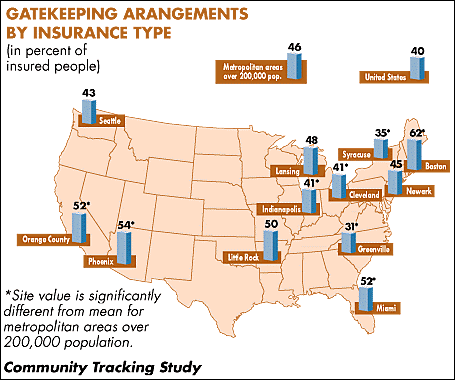
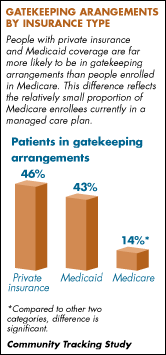
 orty percent of Americans with health insurance report that they are in gatekeeping arrangements in which their primary care physician controls their access to specialists. Findings from two surveys conducted by the Center for Studying Health System Change show how pervasive this feature of American health insurance has become. More than half of insured persons in Boston (62 percent) and Phoenix (54 percent) are in gatekeeping arrangements. Even in those communities with relatively few patients in gatekeeping, such as Greenville, S.C. (31 percent), and Syracuse (35 percent), one out of every three insured persons has a primary care gatekeeper.
Proponents of gatekeeping argue that having a single physician coordinate and monitor all the care that a patient receives improves quality and lowers the cost of care by reducing unnecessary or inappropriate -- and often expensive -- specialty services. This role of primary care physicians may be particularly important for people with chronic medical conditions, who are more likely to receive care from several different physicians.
Critics fear, however, that gatekeeping arrangements, especially when coupled with other administrative and financial incentives to reduce costs, could restrict patients’ access to specialists, even when such services would be beneficial.
PHYSICIAN PARTICIPATION IS HIGH
 espite many physicians’ initial reluctance and ongoing concern about gatekeeping, the Center found that 91 percent of primary care physicians in the United States serve as a gatekeeper for at least some of their patients. The far-reaching nature of this trend is evident in that 96 percent of physicians in group practices and only slightly fewer in solo- or two-physician practices -- 88 percent -- serve as gatekeepers.
On average, primary care physicians who are gatekeepers serve in this role for 4 out of every 10 of their patients. The percentage of patients in gatekeeping is higher among general pediatricians (52 percent) than general internists (40 percent) or family practitioners (39 percent).
| Primary Care Physicians Serving as Gatekeepers (in percent) | Patients for Whom Doctor Serves as Gatekeeper1 (in percent) | |
| All primary care physicians | ||
| Practice Type | ||
| Solo- or two-physician practice | ||
| Group practice (3 or more physicians) | ||
| Group- or staff-model HMO | ||
| Physician Specialty | ||
| General pediatricians | ||
| General internists | ||
| Family practitioners | ||
|
+Compared to primary care physicians in solo- or two-physician practices, difference is significant. *Compared to general pediatricians, difference is significant. 1Reports findings only for primary care physicians serving as gatekeepers. Community Tracking Study |
||
THE FUTURE OF GATEKEEPING
 n an effort to address concerns about gatekeeping, health plans and policymakers are beginning to take action. In response to marketing and patient satisfaction information, many health plans are considering ways to offer patients more direct access to specialists through self-referral and a broader choice of physicians through point-of-service options.
Concerns voiced by patient advocacy groups and some physicians have led state and federal regulators to consider ways to ensure patients’ access to specialists. Florida and Georgia are the first two states to implement legislation requiring that patients be allowed to see certain specialists -- dermatologists -- without going through a gatekeeper. Several other states are considering similar action. The Center will track these and other developments that may contribute to further changes over time in the role of primary care physicians and access to specialists.
This Data Bulletin presents preliminary findings from the Household and Physician Surveys conducted in 1996 and 1997 as part of the Community Tracking Study. The Household Survey is a nationally representative telephone survey of the civilian, non-institutionalized population; it included 43,771 persons in 23,554 families. The Physician Survey is a nationally representative telephone survey of non-federal, patient care physicians (excluding certain specialities -- e.g., radiology, anesthesiology, pathology); it included 9,264 physicians, of whom 5,160 are primary care physicians. All comparisons and differences described in the text are statistically significant at the p<0.05 level.
